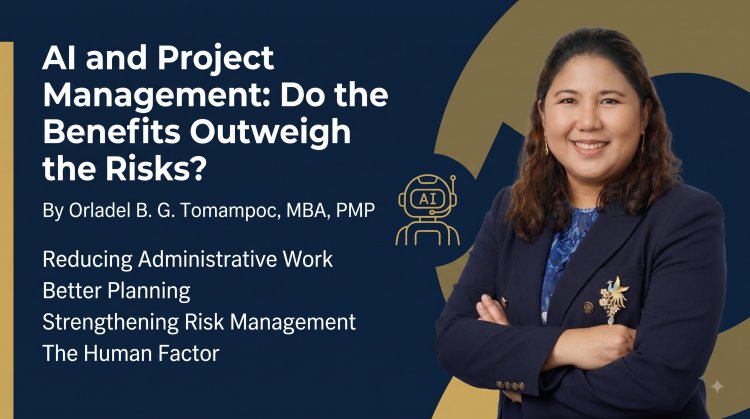
AI and Project Management: Do the Benefits Outweigh the Risks? By Orladel B. G. Tomampoc, MBA, PMP
Artificial intelligence is transforming project management by helping professionals automate administrative tasks, improve planning, strengthen risk management, analyze information, and communicate more efficiently. However, AI also introduces risks involving accuracy, bias, confidentiality, overdependence, and accountability. This article explains why the benefits of AI in project management can outweigh the risks when organizations apply proper governance, reliable data, security controls, human oversight, and responsible decision-making. It also explores how AI is changing the role of project managers and why leadership, judgment, ethics, communication, and AI literacy will remain essential skills for future project professionals.
Artificial intelligence is no longer a future concept for project management. It is already changing how project managers prepare plans, study data, communicate with stakeholders, monitor risks, and make decisions.
For many project professionals, the important question is no longer whether AI should be used. The more relevant question is this:
Do the benefits of AI in project management outweigh its risks and limitations?
My answer is yes—but only when AI is used responsibly, strategically, and with human oversight.
AI Can Reduce Administrative Work
Project managers spend a significant amount of time preparing reports, summarizing meetings, updating schedules, organizing information, writing emails, and following up on action items.
These responsibilities are necessary, but they can consume time that should also be spent on leadership, problem-solving, stakeholder engagement, and team development.
AI can help draft meeting minutes, summarize lengthy documents, organize project information, create initial reports, prepare communication templates, and identify action items.
The Project Management Institute recognizes that AI can support planning, analysis, decision-making, delivery, and project oversight.
This does not mean project managers should automatically accept everything produced by an AI system. It means they can use AI to prepare a first draft, reduce repetitive work, and create more time for responsibilities that require experience and judgment.
AI Can Support Better Planning
Planning is one of the most important parts of project management. However, project plans are often created using incomplete information, assumptions, historical records, and estimates from different stakeholders.
AI can help analyze previous projects, identify patterns, compare scenarios, and suggest possible timelines, resource requirements, dependencies, and risks.
For example, an AI-assisted system may notice that a particular activity usually takes longer than estimated or that a certain type of dependency has caused delays in previous projects. It may also help project managers examine the possible effects of changing a deadline, reducing a budget, or reallocating resources.
These capabilities can improve the quality of planning, but AI recommendations must remain recommendations—not automatic decisions.
Every project has its own organizational culture, political realities, stakeholder expectations, contractual obligations, and human concerns. These factors may not be fully represented in the available data.
The project manager must still ask:
Is the recommendation realistic?
Is it ethical?
Does it support the project’s purpose?
What effect will it have on the team and stakeholders?
AI Can Strengthen Risk Management
Risk management is another area where AI offers significant value.
Traditional risk management often depends on workshops, checklists, expert opinions, and lessons learned from previous projects. These remain important, but AI can help review larger volumes of information and detect risks that may otherwise be overlooked.
It can examine project reports, schedules, issue logs, financial information, and operational data to identify warning signs.
It may detect recurring delays, unusual spending patterns, resource conflicts, or changes in team performance. This can allow project managers to respond earlier instead of waiting for a small concern to become a major problem.
However, AI cannot guarantee that all risks will be identified. It can only work with the data, instructions, and systems available to it.
Poor-quality or incomplete data can produce misleading conclusions. Therefore, the use of AI must be supported by proper data management, regular validation, and experienced human review.
AI Can Improve Communication—but Not Replace Relationships
AI can help project managers communicate more efficiently.
It can summarize technical information, simplify complex reports, prepare presentations, translate content, and adjust a message for different audiences.
This is particularly useful in large or international projects involving many departments, locations, and stakeholder groups.
However, effective communication is not only about producing correct words.
A project manager must understand when a stakeholder is worried, when a team member is losing confidence, when resistance is developing, or when an issue requires a private and sensitive conversation.
AI may help prepare the message, but it cannot fully replace empathy, trust, credibility, negotiation, and personal leadership.
Project management is ultimately about people. Projects are delivered through human cooperation, not technology alone.
The Risks Must Not Be Ignored
Despite its advantages, AI introduces serious risks.
AI can generate incorrect information, misunderstand context, reproduce bias, expose confidential information, or create recommendations that appear convincing but are not supported by reliable evidence.
There is also a danger that project managers may become too dependent on AI.
A project manager who accepts AI-generated schedules, forecasts, reports, or decisions without proper review may create more risk rather than less.
Efficiency should never come at the expense of accountability.
Organizations must establish clear policies regarding what information may be entered into AI systems, which tools are approved, how outputs must be checked, and who remains responsible for the final decision.
The Project Management Institute’s 2026 global AI standard reflects the growing need for a structured, responsible, and technology-neutral approach to using AI across portfolios, programs, and projects.
AI Will Change the Project Manager’s Role
AI will not simply make existing project-management tasks faster. It will gradually change the role itself.
As more administrative and analytical work becomes automated, project managers will be expected to provide greater strategic value.
They will need to become stronger in leadership, business understanding, change management, governance, ethical decision-making, communication, and benefits realization.
They will also need enough AI knowledge to question its outputs, understand its limitations, and apply it appropriately.
AI literacy is therefore becoming an important professional competency.
PMI has emphasized that project managers must learn how to use AI to increase productivity, efficiency, and project success while leading its adoption responsibly.
Project managers do not necessarily need to become programmers or data scientists. But they must understand how AI affects project planning, execution, risk, governance, stakeholders, and organizational change.
The Benefits Outweigh the Risks—with Proper Governance
AI’s benefits in project management outweigh its disadvantages because it can reduce repetitive work, improve access to information, strengthen planning, support risk identification, and help project managers make more informed decisions.
But these benefits are not automatic.
An organization cannot simply purchase an AI tool and expect its projects to improve.
Successful adoption requires clear objectives, appropriate training, reliable data, responsible governance, security controls, and a culture that encourages people to question AI-generated outputs.
The strongest model is not AI replacing the project manager.
It is the project manager using AI as a capable assistant while remaining fully responsible for the project’s direction, decisions, relationships, and outcomes.
AI can process information quickly. It can discover patterns and prepare recommendations.
But the project manager must provide context, accountability, empathy, ethics, and leadership.
The future of project management will not be human versus artificial intelligence.
It will be human judgment strengthened by artificial intelligence.
Project managers who understand this balance will not only become more efficient—they will be better equipped to lead increasingly complex projects in a rapidly changing world.
About the Author
Orladel Berdiomil G. Tomampoc, MBA, PMP, is a transformation and program management leader with more than 15 years of experience in business and digital transformation, enterprise program management, project management, process improvement, governance, shared services, organizational change, and complex business initiatives.
She has held senior leadership and management roles in multinational environments, with professional experience spanning the United States, Europe, and the Asia-Pacific region.
As Founder and Principal Consultant of Orladel Tomampoc Consulting, she works with organizations and leadership teams to turn strategy into disciplined execution, simplify complex business challenges, strengthen governance, align stakeholders, and deliver measurable and sustainable results.
Her professional background includes transformation management, enterprise program management, project governance, technology operations, financial services, risk management, process improvement, and shared services.
She holds a Master’s in Business Administration and is a certified Project Management Professional (PMP). Her professional development also covers areas such as agile delivery, change management, technology service management, operational excellence, data analytics, artificial intelligence tools, executive leadership, and organizational transformation.
Through her articles and professional work, she shares practical perspectives on leadership, project management, transformation, technology, governance, and the changing demands facing today’s organizations and business leaders.
She holds a Master’s in Business Administration and is a certified Project Management Professional (PMP). Her professional development also covers areas such as agile delivery, change management, technology service management, operational excellence, data analytics, artificial intelligence tools, executive leadership, and organizational transformation.
Through her articles and professional work, she shares practical perspectives on leadership, project management, transformation, technology, governance, and the changing demands facing today’s organizations and business leaders.



























![[Action required] Your RSS.app Trial has Expired.](https://rss.app/static/img/images/rss-app.png)